Diagnose brown lawn patches fast with simple checks, including tug and moisture tests. Repair damage from drought stress, fungal disease, or grubs and preven...
lawn care
How Long to Water Your Lawn
 Mark Vance
 is a former professional landscaper and the lead turf enthusiast at Yard Mentor. With over 15 years of experience in soil health, turf management, and residential landscaping, he is dedicated to helping homeowners transform frustrating dead patches into lush, healthy lawns. When he isn't testing new grass seed blends, you can find him enjoying a Saturday morning coffee looking out over his freshly striped yard.
Updated October 17, 2026
Created October 17, 2026
Mark Vance
Mark Vance is a former professional landscaper and the lead turf enthusiast at Yard Mentor. With over 15 years of experience in soil health, turf management, and residential landscaping, he is dedicated to helping homeowners transform frustrating dead patches into lush, healthy lawns. When he isn't testing new grass seed blends, you can find him enjoying a Saturday morning coffee looking out over his freshly striped yard.
Updated October 17, 2026
Created October 17, 2026
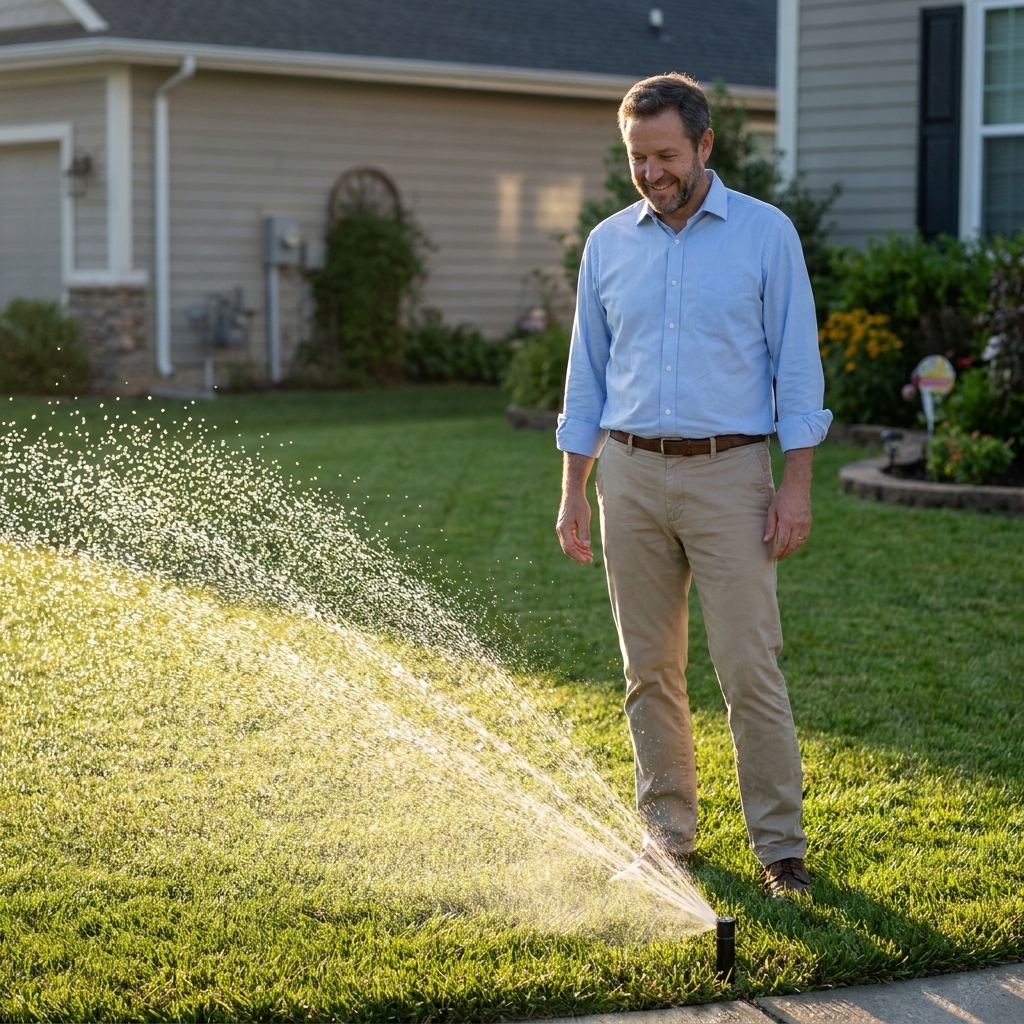
If you have ever stood at the window watching sprinklers run and thought, Is this helping, or am I just paying to grow mushrooms? you are not alone. The goal is not to keep the surface wet. The goal is to push water down into the root zone so grass learns to reach for it.
For most established lawns, the sweet spot is deep and infrequent watering. That means watering long enough to wet the active root zone, then waiting until the lawn actually needs it again. Done right, you get a tougher lawn that handles heat better and is less likely to develop fungal problems.
The quick answer (then how to dial it in)
If you want a starting point you can use today:
- Water 2 to 3 times per week in summer for many established lawns (not daily).
- Aim for about 1 inch per week (rain plus irrigation), then adjust up or down based on heat, wind, sun, soil, and your grass type. In some climates and peak summer heat, 1.5 inches may be appropriate. In cooler or coastal weather, it can be too much.
- Per session run time is often 20 to 60 minutes per zone, depending on your sprinkler output, soil intake, and slope.
The honest truth: minutes are a poor measurement. Inches of water applied is what matters. One sprinkler might put down 0.3 inches per hour, another might put down 1.5 inches per hour. Same “30 minutes” can be a drizzle or a flood.
Also, your lawn’s needs are not just “one size fits all.” Cool-season lawns (fescue, bluegrass, rye) often struggle more in peak summer and may go semi-dormant. Warm-season lawns (Bermuda, zoysia, St. Augustine) love heat but still need smart watering. The method below works for both. You just adjust the totals and timing to match your conditions.
What deep watering means
Most turfgrass roots are concentrated in the upper part of the soil profile. In ideal conditions, roots can reach close to a foot deep, but in many home lawns the most active roots are often in the top 4 to 8 inches, especially if soil is compacted or watering has been frequent and shallow.
Deep irrigation means:
- Water long enough that moisture reaches roughly 6 inches deep as a practical target (sometimes 4 inches is all your soil will allow at first, and sometimes you can wet 8 inches or more).
- Then allow the upper soil to partially dry before watering again.
- Repeat. Roots follow that moisture line downward.
Measure sprinkler output (the tuna-can test)
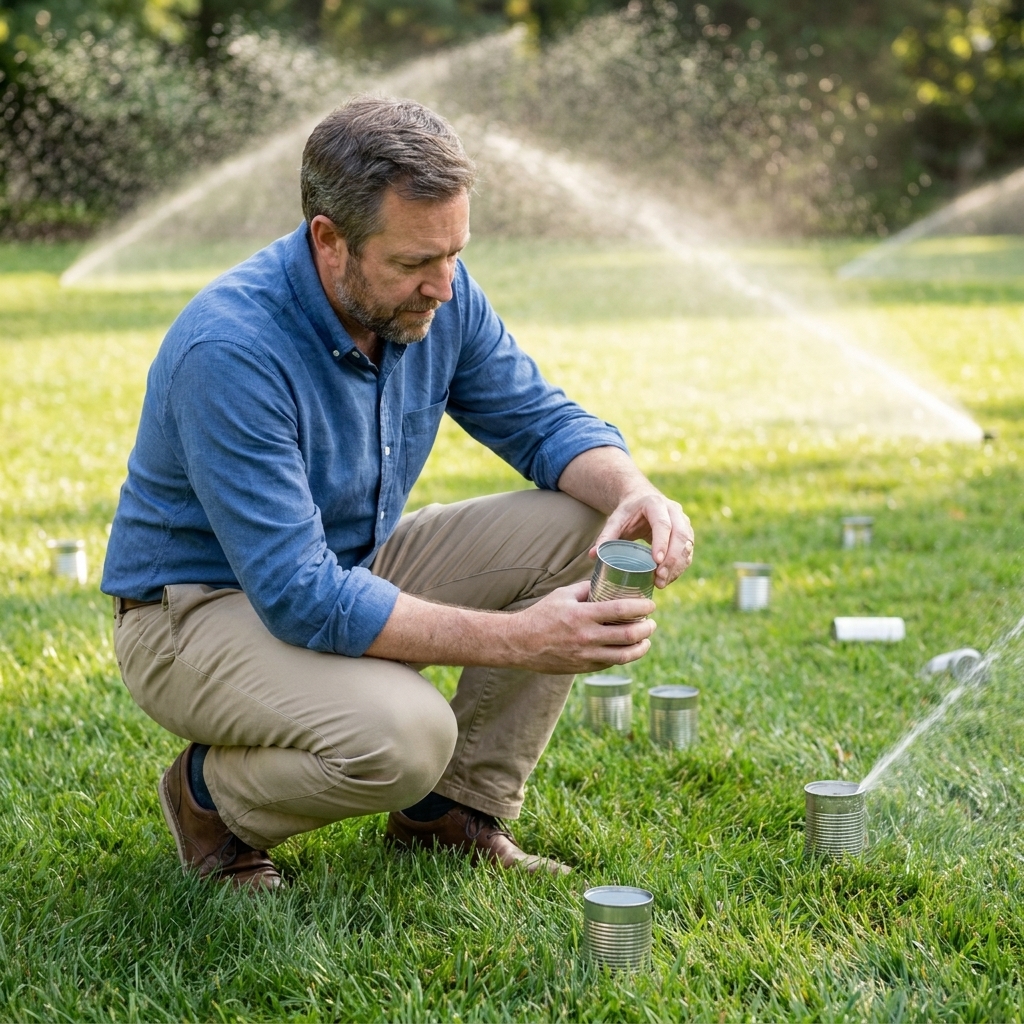
This is the step that makes everything click. You only need 10 minutes and a few identical containers.
What you need
- 5 to 8 flat-bottom containers (tuna cans, cat food cans, or small straight-sided cups)
- A ruler marked in inches
- Your sprinklers running like normal
How to do it
Place containers around one zone: near the sprinkler, far from it, and in the corners.
Run that zone for 15 minutes.
Measure the water depth in each container and average the results.
Convert to inches per hour: multiply your 15-minute average by 4.
Example: If you average 0.2 inches in 15 minutes, your system applies about 0.8 inches per hour.
Now you can calculate run time based on a real target, not guesswork.
How long to water (simple formula)
First decide how much you want to apply per session. These are practical starting ranges, not laws of nature. Your goal is to match what your soil can absorb without runoff and to wet the root zone you actually have.
- Clay or compacted soil: about 0.25 to 0.5 inches per session (often best done with cycle-and-soak to prevent runoff)
- Loam: about 0.4 to 0.6 inches per session
- Sandy soil: about 0.5 to 0.75 inches per session (drains fast, so you may water a bit more often)
Then calculate:
Run time (minutes) = (Target inches ÷ inches per hour) × 60
Example: Your sprinklers put down 0.8 inches per hour. You want 0.5 inches this session.
Run time = (0.5 ÷ 0.8) × 60 = 37.5 minutes
Round to about 38 minutes for that zone.
How often to water
Many established lawns do best with 2 to 3 deep waterings per week during hot weather, adjusted for rainfall. In milder conditions, once a week can be enough. The exact schedule depends on rainfall, temperatures, wind, soil, sun exposure, and your local evapotranspiration (ET). If you have access to local ET data or a smart controller, use it. It beats guesswork.
A simple schedule for many lawns
- Spring: 1 to 2 times per week, adjusting for rain
- Summer: 2 to 3 times per week (sometimes more often for sandy soils or extreme heat and wind)
- Fall: 1 to 2 times per week until dormancy
If your lawn is newly seeded or newly sodded, that is a different situation. Those cases require lighter, more frequent watering at first. Deep and infrequent is the long-term goal once the grass is established.
One more real-world note: follow local watering restrictions (days and times), and make sure your system has a working rain sensor or smart shutoff so you are not watering during a storm.
Best time to water
Early morning is the gold standard, usually between 4 a.m. and 9 a.m.
- Less wind, so sprinklers distribute more evenly.
- Cooler temperatures mean less evaporation.
- Grass blades dry out after sunrise, reducing disease risk.
Night watering is usually not ideal because it can keep leaf blades wet for a long stretch, which can encourage some fungal diseases, especially in warm, humid weather. That said, some arid regions and utilities prefer nighttime watering to reduce evaporation. If night watering is your only option, aim for a schedule that still allows the lawn to dry as soon as possible, and do not overdo the frequency.
Midday watering is not “wrong” if your lawn is in real heat stress and you are trying to prevent damage, but it is the least efficient time. If you must water midday, keep it short and targeted.
How to tell if you watered enough
Use a screwdriver test
About an hour after watering, push a long screwdriver into the soil.
- If it slides in around 6 inches fairly easily, you watered deeply for most lawns.
- If it stops at 2 to 3 inches, you watered too lightly.
Watch the lawn’s thirst signals
- Footprints linger instead of springing back.
- Color shifts from green to dull bluish-gray.
- Leaf blades fold lengthwise to reduce water loss.
Those are your cues to water. If you water on a rigid calendar no matter what, you will almost always overwater at some point in the season.
Stop runoff and wasted water
Cycle and soak for slopes and heavy soil
If water starts running down the driveway, you are not “watering deeper.” You are just moving water sideways.
Runoff happens when your sprinkler’s precipitation rate (how fast it applies water) exceeds your soil’s infiltration rate (how fast it can soak in). The fix is to give the water time to move downward.
For compacted soil, clay, or slopes, use cycle and soak:
- Run the zone for 10 to 15 minutes
- Stop for 30 to 60 minutes to let water soak in
- Repeat until you hit your target inches for the session
Check sprinkler coverage
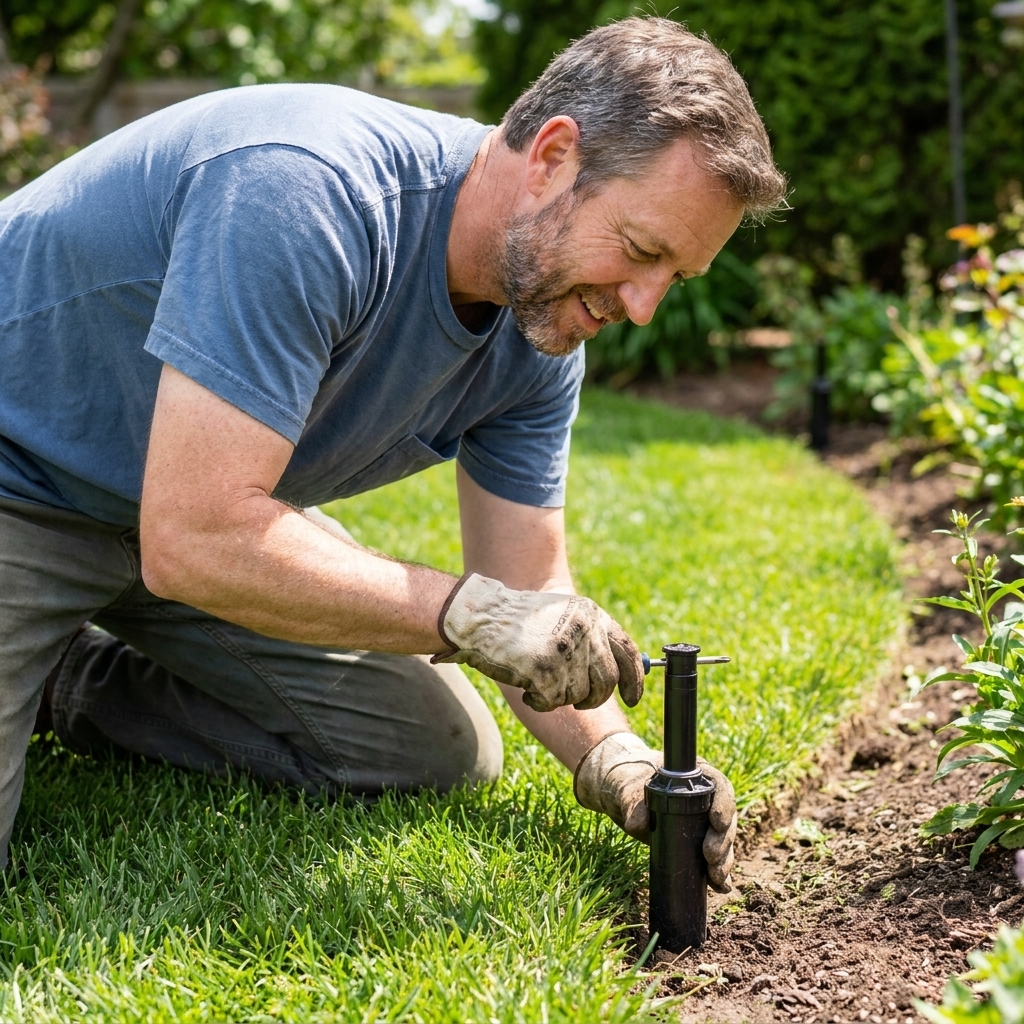
Dry spots often come from poor overlap, clogged nozzles, or heads that are tilted or sunk too low. If one area always looks stressed, do not automatically add more time to the whole lawn. Fix the coverage first.
Deep watering and fungus
Fungus loves two things: constantly damp conditions and stressed turf. Overwatering can create both.
Deep and infrequent watering helps because:
- You wet the soil thoroughly, then allow the surface to dry between waterings.
- Roots grow deeper, making grass more resilient to heat stress.
- Morning watering reduces the time grass blades stay wet.
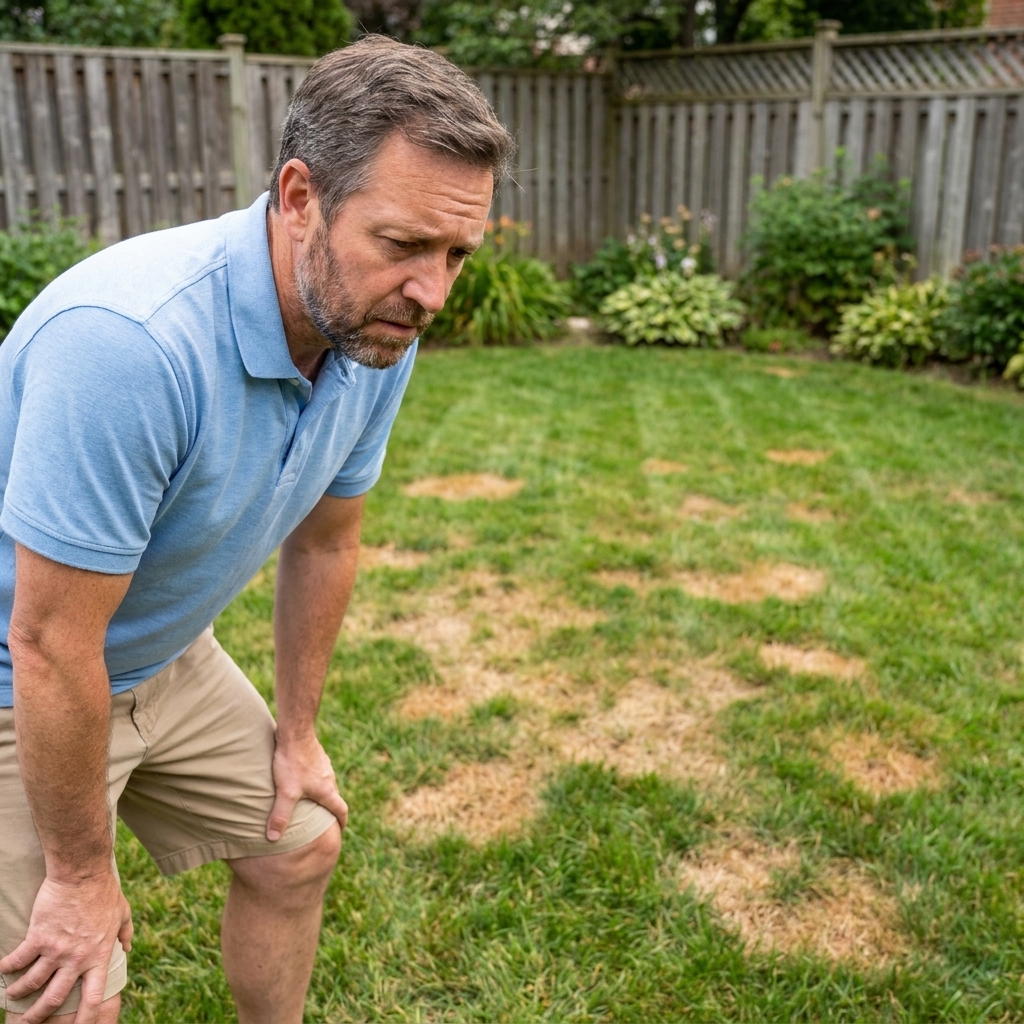
If you are battling brown patch, dollar spot, or other common lawn diseases, one of the first things I look at is watering frequency, not just fungicide.
Zone run time examples
These are not universal, but they give you a realistic feel for what “deep watering” can look like once you measure output. Nozzle choice, pressure, spacing, and head type can change these a lot, so use them as ballpark ranges.
- Rotors: often around 0.4 to 0.8 in/hr. That can be 30 to 75 minutes to apply 0.4 to 0.6 inches.
- Spray heads: often around 1.0 to 2.0 in/hr. That can be 12 to 35 minutes to apply 0.4 to 0.6 inches. If your sprays are on the high end, runoff becomes more likely, so cycle and soak may be needed.
- Low-output or micro spray: often around 0.2 to 0.6 in/hr. That can be 40 to 120 minutes to apply 0.3 to 0.6 inches.
Your tuna-can results will tell you where you fall.
Special situations
New seed
Keep the top half inch of soil consistently moist until germination and early establishment. That often means 2 to 4 light waterings per day for short bursts, then gradually transitioning to deeper watering over the next few weeks.
New sod
For the first 1 to 2 weeks, sod needs frequent watering so it can knit roots into the soil below. After it starts rooting (you cannot easily lift a corner), shift toward deeper watering.
Shade
Shady areas dry out slower, so they generally need less frequent watering. Overwatering shade is a sneaky way to invite disease.
Heat waves
During extreme heat, you may need to water a bit more often, but keep the deep-watering mindset. If the lawn is wilting by afternoon, a short midday syringing (2 to 5 minutes) can cool the canopy without soaking the soil. Think of it as first aid, not a replacement for your morning deep watering.
Common watering mistakes
- Watering every day out of habit.
- Using “minutes” without measuring output.
- Watering too often in humid weather, then wondering why fungus shows up.
- Cranking up run time to fix dry spots instead of correcting sprinkler coverage.
- Ignoring rain. A soaking rain can cover most or all of the week’s watering, but only if it actually infiltrates where you need it.
FAQ
Is 20 minutes of watering enough for a lawn?
Sometimes, but only if your sprinkler output is high. If your spray heads apply around 1.5 inches per hour, 20 minutes can deliver about 0.5 inches, which is a solid deep-watering session for many soils. If your system is lower output, 20 minutes might barely wet the surface.
Is it better to water longer or more often?
For established turf, longer and less often is usually better. It promotes deeper roots and reduces constant surface moisture that can encourage disease.
How do I know if I am overwatering?
Watch for soggy soil, squishy footsteps, mushrooms, algae on bare soil, and thin grass that looks yellowish despite “plenty of water.” Also, if you see runoff during irrigation, you are applying water faster than the soil can absorb it.
Should I water in two shorter cycles instead of one long run?
If you have clay soil, compaction, a steep slope, or spray heads that apply water fast, yes. Cycle and soak helps water move downward instead of running off.
Takeaway
If you remember one thing: water to a depth, not to a timer. Measure what your sprinklers put down, aim for deep soakings that match your soil’s intake, and let the lawn tell you when it is thirsty. That is how you build a lawn that can handle summer without living on a daily drink.