
A practical spring checklist to bring your lawn out of dormancy: clean-up, soil testing, smarter pre-emergent timing, first mow basics, and gentle feeding fo...
lawn care
Spring Pre-Emergent Weed Control
 Mark Vance
 is a former professional landscaper and the lead turf enthusiast at Yard Mentor. With over 15 years of experience in soil health, turf management, and residential landscaping, he is dedicated to helping homeowners transform frustrating dead patches into lush, healthy lawns. When he isn't testing new grass seed blends, you can find him enjoying a Saturday morning coffee looking out over his freshly striped yard.
Updated October 17, 2026
Created October 17, 2026
Mark Vance
Mark Vance is a former professional landscaper and the lead turf enthusiast at Yard Mentor. With over 15 years of experience in soil health, turf management, and residential landscaping, he is dedicated to helping homeowners transform frustrating dead patches into lush, healthy lawns. When he isn't testing new grass seed blends, you can find him enjoying a Saturday morning coffee looking out over his freshly striped yard.
Updated October 17, 2026
Created October 17, 2026
If you only do one “grown-up lawn care” task in early spring, make it pre-emergent. It is the closest thing we get to a cheat code for crabgrass and a bunch of other warm-season annual weeds. The trick is simple: pre-emergent does not kill existing weeds. It prevents new ones from successfully sprouting.
In this guide, I will walk you through timing, product selection, and a methodical application process that does not require fancy gear or a big budget. Just good timing, even coverage, and the right amount of water.

How pre-emergent works
Pre-emergent herbicides create a thin chemical barrier in the top layer of soil. When a weed seed germinates and tries to send out its first root and shoot, it hits that barrier and fails. That is why timing and watering-in matter so much. The product has to be in the soil zone where germination happens.
Two important realities to keep in mind:
- It will not kill weeds you can already see. If you already have little green crabgrass sprouts, you are late for prevention and need a post-emergent plan.
- It can also affect desirable seed. If you plan to seed or overseed soon, you have to choose carefully or delay pre-emergent.
When to apply
Crabgrass germination is driven by soil temperature, not the date on the fridge. Your goal is to have pre-emergent down right before crabgrass starts germinating.
The sweet spot
Apply when soil temperatures are approaching 55°F at about 2 inches deep for several days in a row. Many extension recommendations use a 3 to 5 day stretch or a 5-day average as the trigger. In many areas, that is early to mid-spring, but it varies year to year.
- Target: 50°F to 55°F soil temps for your first application
- Do not wait for: your lawn to fully green up. Crabgrass can start its move while turf is still waking up.
How to check soil temperature
- Best method: Use a local soil temperature map from a university extension or weather service and confirm with a simple soil thermometer.
- Quick method: Stick a kitchen probe thermometer 2 inches into the soil in a few representative spots, late morning, and average the readings over 3 to 5 days.
If you apply too early
Slightly early is usually better than late, but very early applications can fade before peak germination, especially with shorter-residual actives, low label rates, or unusually wet springs. In plain English: residual control may decline before the weeds are done germinating. That is why many homeowners do better with a split application strategy if the label allows it.
Choose a product
There are several active ingredients that work well for crabgrass prevention. You do not need to memorize chemistry. You just need to match the product to your lawn plans.
Common active ingredients
- Prodiamine: Long residual, great crabgrass prevention. Not friendly for spring seeding because it can prevent grass seed from establishing.
- Dithiopyr: Strong pre-emergent and has limited early post-emergent activity on very young crabgrass (think 1 to 3 leaf or very early tiller stages). Still not ideal if you plan to seed soon.
- Pendimethalin: Solid option, often found in homeowner granular products. Residual can be a bit shorter than prodiamine depending on rate and conditions.
- Mesotrione (Tenacity-type products): Useful if you must seed in spring for many cool-season grasses. It can help suppress certain weeds during establishment, but it is not a long-lasting crabgrass barrier in the way prodiamine is. Many seeding-time programs use mesotrione as a helper and then transition to a standard pre-emergent later, as allowed by the label and your grass type.
My neighborly rule: If you are not seeding this spring, prodiamine or dithiopyr are usually the easiest wins. If you are seeding, pause and plan around that first.
Two quick checks
1) Are you seeding soon?
If you plan to seed or overseed in the next 6 to 12 weeks, a standard pre-emergent can sabotage your work. For cool-season lawns, fall is typically the best time to seed anyway. If bare spots are forcing your hand in spring, consider:
- Spot treating pre-emergent only where you are not seeding.
- Using a seeding-compatible option (mesotrione-based products) and following the label precisely.
- Delaying pre-emergent and accepting you will do more post-emergent weed control later.
2) What weeds are you targeting?
Spring pre-emergent is the core move for crabgrass and other summer annual weeds (mostly grassy, plus some annual broadleaves depending on the product). It is not a cure-all for dandelions and other perennial broadleaf weeds. For those, you usually need:
- Fall broadleaf control (best time)
- Spring spot spraying with a selective post-emergent once weeds are actively growing
How to apply
This is the method I used for years on residential lawns. It is slow and steady, and it works.
Step 1: Granular or liquid
- Granular: Easier for most homeowners. Apply with a broadcast spreader. Must be watered in.
- Liquid: Excellent coverage when applied evenly with a pump or backpack sprayer. Requires careful measuring and calibration.
If you are new to this, granular is typically the least stressful route.
Step 2: Measure your lawn
Do not guess. Product labels are rate-sensitive. If you overapply, you waste money and can stress turf. If you underapply, weeds slip through.
- Use your property survey, a mapping app, or pace it off and calculate square footage.
- Split your lawn into zones (front, side, back) so you can apply evenly.
Step 3: Calibrate your spreader or sprayer
For granular products, set your spreader to the label-recommended setting only as a starting point. Spreader models vary. The safest approach is the “two-pass method”:
- Apply half the product in one direction.
- Apply the other half perpendicular to the first pass.
This dramatically reduces stripes and missed lines.
Step 4: Apply on a calm, dry day
- Avoid windy conditions, especially near flower beds and vegetable gardens.
- Do not apply right before a downpour that could wash product off-target.
- Mow first if your lawn is shaggy. You want product to reach the soil, not get hung up in tall blades.
Step 5: Keep it on the lawn
Be a little picky here. It helps your results and it is the responsible move.
- Do not broadcast onto driveways and sidewalks. If granules land on hard surfaces, sweep or blow them back onto the turf.
- Be careful on turns and overlaps. Slow down, reduce extra passes, and do not dump heavy rates at the end of a line.
- Leave clean edges near beds. A narrow no-throw strip or careful hand-shake at the border keeps product where you want it.
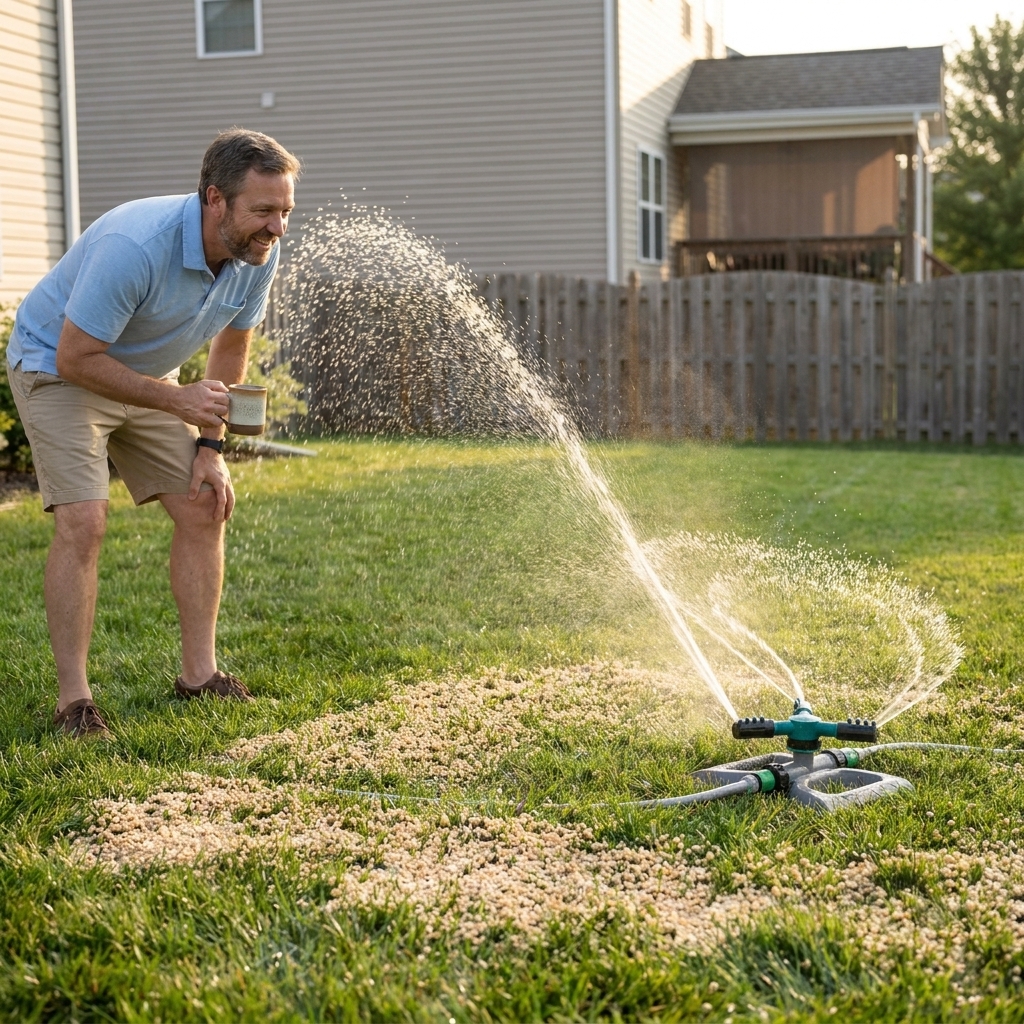
Step 6: Water it in
Most pre-emergents need to be moved into the top layer of soil. A common rule of thumb is 0.25 to 0.5 inches of water within 24 hours, but labels vary, and many products call for right around 0.5 inch. Always check your specific label.
- Rain works if it is gentle and consistent.
- Irrigation works if you can control the amount.
If you skip watering-in, you can end up with pre-emergent sitting on the surface where it breaks down faster and does not form a good barrier.
Split application
If your product and label allow it, a split application improves coverage and extends protection through peak germination.
Simple split schedule
- First half-rate: when soil temps approach 50°F to 55°F
- Second half-rate: 4 to 6 weeks later
This approach is especially helpful in regions with unpredictable springs, frequent rain, or long warming periods.
If crabgrass shows up
Even with a good pre-emergent program, you might see a few breakthrough weeds along edges, thin spots, or areas where coverage was uneven. Do not panic.
First, diagnose the weak point
- Thin turf: crabgrass loves sunlight hitting bare soil. Plan to thicken turf with proper mowing, feeding, and fall overseeding.
- Missed strip: classic spreader skip. Next time, use the two-pass method.
- Late watering-in: the barrier never formed well.
Then, use a targeted post-emergent
For crabgrass, look for a selective post-emergent labeled for your grass type. One common active ingredient in crabgrass killers is quinclorac (often in combination with other actives), but the right choice depends on your turf and the size of the crabgrass. Apply when crabgrass is young and actively growing. Always follow label instructions and temperature restrictions to avoid turf injury.
Common mistakes
- Applying after crabgrass has already germinated. If you can see crabgrass seedlings, shift to post-emergent control.
- Skipping the watering-in step. Pre-emergent needs soil contact to work.
- Using “weed and feed” as a one-and-done solution. These can be fine products, but the fertilizer timing may not match what your lawn needs, and coverage is often uneven if you rush.
- Overapplying. More is not better. It is just more risk and more cost.
- Applying right before seeding. This is the heartbreak special. Plan your season before you spread anything.
- Letting product sit on pavement. Sweep it back onto the lawn to reduce runoff and waste.
Notes by lawn type
Cool-season lawns
For Kentucky bluegrass, fescue, and ryegrass lawns, spring pre-emergent is very common, but fall is still your best seeding window. If your lawn is thin, consider prioritizing fall overseeding and use spring pre-emergent to hold the line against crabgrass.
Warm-season lawns
For Bermuda, zoysia, St. Augustine, and centipede, pre-emergent is a cornerstone of weed control. Many warm-season lawn programs use both a fall application (to reduce winter annuals) and a spring application (for summer annuals), depending on region.
Also note: some weeds, like goosegrass, tend to germinate later than crabgrass in many areas. Your spring timing may still start with crabgrass, but a split application can help carry protection into that later window when it matters.
FAQ
Can I apply pre-emergent and fertilizer together?
Yes, if you use a combination product or you apply them separately on the same day. Just make sure the fertilizer timing and rate fit your lawn’s needs, and remember that the pre-emergent still must be watered in.
Do I need to dethatch or aerate before pre-emergent?
If you are planning core aeration, do it before pre-emergent. Aeration after application can disrupt the barrier. Light dethatching can be done before as well if needed, but do not create lots of bare soil right before weed season without a plan to thicken turf.
How long does pre-emergent last?
It depends on the active ingredient, application rate, soil type, and rainfall. Many programs aim for coverage through late spring and early summer, often supported by a split application.
Is pre-emergent safe for pets and kids?
When used according to the label, most homeowner products are designed to be used around residential lawns. Keep pets and kids off the lawn until the application is complete and the product is watered in and the area is dry, or follow the specific label guidance for re-entry.
Simple spring plan
If you want the short version you can stick on the fridge:
- Start watching soil temps as spring approaches.
- Apply pre-emergent as temps near 55°F (think a 3 to 5 day trend or 5-day average).
- Use the two-pass method for even coverage.
- Water it in with about 0.25 to 0.5 inches, or whatever your label specifies (often around 0.5 inch).
- Consider a split application 4 to 6 weeks later if the label allows.
Get this one step right and you will spend a whole lot less time fighting crabgrass later, and a whole lot more time enjoying that first real mow of the season.